
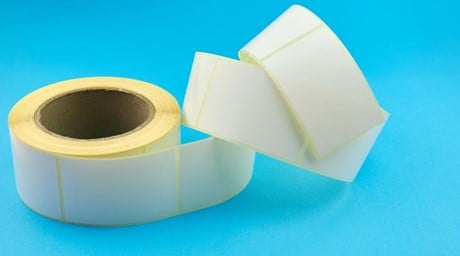
Thermolabels allow fast labelling of packages, products and stocks. In order for the printout to remain legible and the label to adhere, the printer, material and application must fit together. The distinction between thermal direct and thermal transfer pressure is particularly important.
Two different procedures
In direct thermal pressure, a heat sensitive layer of the label reacts to the print head. No ribbon is needed for this. In the case of thermal transfer printing, the heated print head transfers color from a matching ribbon to the label material. This procedure requires appropriately coordinated consumables.
Zebra explains the two methods and their fields of application. Thermodirect pressure is often useful for short-lived information. A suitable thermal transfer structure can be useful for more durable markings; durability depends on material and ribbon.
ECO and TOP
In retail trade: ECO often an uncoated thermal material, TOP a design with additional protective layer. This can improve resistance to certain influences. However, the name alone does not guarantee any water, chemical or UVPermanence. Read the data of the specific material.
Thermal direct imprints may be affected by heat, light or contact with certain substances. Store labels according to the manufacturer’s specifications. A flat-rate readability period for all products would be unreliable.
The adhesive belongs to the selection
A durable expression helps little if the label dissolves. Check surface, bonding temperature and later environment. Suitable materials and adhesives are required for refrigerated or frozen goods. A protective coating alone does not automatically make a label a frozen label.
Tuning the Role and Printer
- Label width and height must fit the print file and the usable print width.
- Roll core and maximum outer diameter must fit into the device.
- The printer must support the gaps or brand recognition used.
- Printing procedures, resolution and media settings must be selected correctly.
- After a material change, calibration and test pressure may be necessary.
100 × 150 mm is a frequently offered shipping format, but not a universal measure for all shipping services. Use the presentation of the specific service. Small product labels require a resolution with which fonts and codes are still reliably readable.
Check barcodes in the real process
A EAN- or other barcode needs enough contrast and free areas. Check the printout with the scanner actually used. Too high pressure temperature can cause fine lines to run; too low settings can create gaps. The correct setting is based on device and material, not a flat-rate number.
Colored stickers can also be used for visual sorting. Set clear internal rules for this. They do not replace a correct article identity or readable machine-processable marking. A pattern run before a large purchase prevents many later interruptions at the packing place.
Comments
No comments yet. Share your experiences on this topic.