
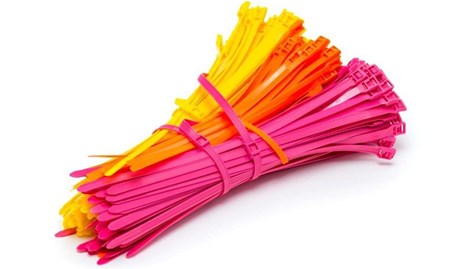
Cable ties arrange cables, attach light markings and bundle matching items. Their simple locking system makes them practical. For a reliable application, however, length, material, load capacity and environmental conditions must be right.
Material and colour
Many common cable ties are made of polyamide. In addition, there are variants for special conditions, such as removable binders or products from other materials. A black color does not automatically mean a occupied UVPermanence. Check explicitly the information on indoor or outdoor use.
Temperature range and chemical resistance are also product specific. Do not take any standard values only from the material designation. For demanding installations or safety-relevant fastenings, the intended execution is required.
Length and load capacity
The length shall be sufficient for the circumference of the bundle and the closure. The usable bundle diameter may be in the data; a simple calculation with the entire belt length does not take into account the head and the required end completely. The width can be related to the strength, but does not replace any specific load specification.
A specified strength value is not automatically a permissible working load for each application. Please observe measuring conditions, direction of load and manufacturer’s instructions. Common cable ties are not a general replacement for designed load securing.
Installing correctly
- Choose a suitable binder and put the bundle together without unnecessary tension.
- Run the tape through the head in the intended direction.
- Drag it only as it is required for the task.
- Prevent pressure points or damage to cable insulation and sensitive parts.
- Cut one overhanging end cleanly with a suitable tool without leaving sharp edges.
In many similar applications, a mounting tool designed for this purpose can ensure a more controlled processing. In the case of electrical cables, the respective installation requirements must also be observed.
Disposable or resolvable?
An ordinary cable tie is usually removed by careful cutting. Keep the cutting tool away from cables and other parts. Attempts to bend the buckle with a needle can damage material and contents.
Removable binders have a mechanism for this purpose. Use it according to manufacturer’s instructions and check the binder before re-use. A damaged closure should not be reused.
Organisation and storage
Colors can help with the assignment of lines or product groups. Set a clear internal system for this. Store binders according to the manufacturer’s instructions, preferably in their intended packaging. In this way, sizes and characteristics remain recognizable and unsuitable variants are not accidentally taken over into another process.
Comments
No comments yet. Share your experiences on this topic.